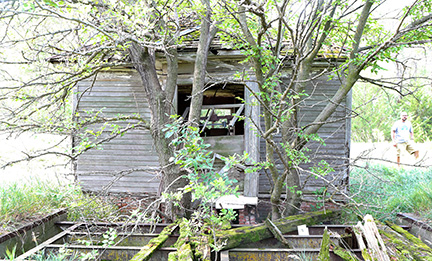
A now-overgrown scale house that used to weight loads of sugar beets is one of the few remaining structures from the Standard Beet Sugar Company of Leavitt.
The Fate of Sugar City:
Pieces of Leavitt scattered after plant's closing
by Nathan Arneal
Published 9/20/23
When you’re zooming along the new Highway 30 expressway about seven miles east of North Bend, take a look to the north as you cross County Road 14 Boulevard. You will notice a grove of trees about a third of a mile away. That was once the town of Leavitt, Nebraska.
One hundred twenty years ago you would have seen the great Standard Beet Sugar Company factory rising from the plain, surrounded by a village of houses.
The town and the factory it was built around disappeared more than a century ago, but there are still signs.
Life moves on
As the SBSC was liquidated between 1907 and 1910, the houses that populated Leavitt were sold and moved elsewhere. One of the managers’ homes was bought by Oliver Taylor who moved it about a half mile to the south to the ground be bought from the Standard Company. It still stands today, just a few yards down the road from the modern shop and grain bin complex of Taylor Farms, now run by Oliver’s great-great grandchildren.
In 1904, Nat J. Johnson and A.D. Graham bought 700 acres of ground and most of buildings from the Standard Cattle Company in Ames and began selling off smaller parcels, including the piece to Taylor. Johnson, who worked for years as a manager for R.M. Allen and the Standard Cattle Company, continued to use the pens and mammoth barn for feeding livestock but turned most of his attention to sheep, which was a specialty of Graham’s. Graham had been the manager of the Ames Mercantile store.
With the barn and feedyards lying south of the tracks, Johnson planned to sell his lots on the north side of the tracks. Johnson not only took over Allen’s position running the stockyards, but also as Ames’ most prominent resident. He also owned businesses else where, including the Lyric Theater in Fremont.
In the spring of 1911, Johnson and Graham staked out the town site of the “new” Ames, to be laid out north of the tracks. Many of the houses that were spread out south of the tracks were moved to the north side.
Read the full story in the print or e-edition.
<<Back to the front page |