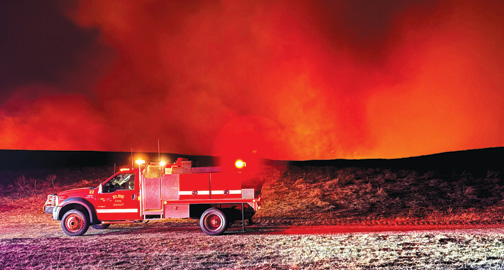
Bryant Emanuel, a North Bend native, was one of many first responders to assist in fighting the historic Morrill Fire, which ravaged over 643,000 acres of land across Western Nebraska. Emanuel is a captain of the Elsie Volunteer Fire Department.
North Bend native battles western fires
by Jason Futch
Published 6/6/06
Since March 19, fires have erupted throughout western Nebraska, devastating the landscape, homes and ranches, burning nearly 900,000 acres and causing much heartache.
North Bend native Bryant Emanuel, a 2008 graduate of NBC and son of Tom and Linda Emanuel, has witnessed firsthand the devastating impact of the recent wildfires. Now living in Elsie in southwest Nebraska, he serves as captain of the Elsie Volunteer Fire Department.
After receiving a mutual aid request, Emanuel and five fellow volunteer firefighters made the three-hour journey to assist with what has been dubbed the Morrill Fire due to is origin in in Morril County. That fire tore through Arthur, Garden, Grant, Keith and Morrill counties. The blaze would become the most significant and destructive fire in Nebraska history.
“It was a 642,000-acre fire, from what we were told,” Emanuel said. “I looked at it, and it was almost double the size of Dodge County that burned. That’s a lot of land.”
While Emanuel said the Morrill Fire was a tough one to battle, it wasn’t his first firefight. When he first started working with the EVFD in 2022, a wild fire broke out about 7 miles north of town. At the time, he had just welcomed a son and had only been with the department a few months.
“It had been a long three days in the hospital, and my phone was still on silent when we got home,” Emanuel said. “My wife came out screaming, ‘Did you look at your phone?’ and I told her no.”
When he checked his phone, he had multiple missed calls requesting assistance to fight the blaze. As a new firefighter, Emanuel struggled to get his equipment on. By the time he was able to assist, the wind had been blowing hard, creating a hazardous situation for him and others battling the fire.
“It was blowing so hard, you couldn’t see across the highway with the smoke and flames,” he said.
According to the Nebraska Emergency Management Agency, the 2022 Elsie Fire burned nearly 5,000 acres, affecting farm and cattle grazing lands. While it was smaller than the Morrill Fire he would later encounter, it gave Emanuel a crash course in firefighting early in his career, preparing him for what was to come.
“We had been called to go a long way to fight fires before,” he said, “so we had an inclination that we would be heading out either that night or the next day.”
While Emanuel monitoring a different wildfire to his southeast, the Cottonwood Fire, he also saw that the Morrill Fire was active but did not believe it would affect his department at the time, as it had not grown significantly.
That changed when he received a notice from the Perkins County Fire Department requesting mutual aid. Emanuel thought they would be assisting the Keystone-Lemoyne Fire and Rescue team with another fire, but when he learned that the Morrill Fire had grown and his team was being dispatched there, he was in disbelief.
“I couldn’t believe it,” Emanuel said. “There’s just no way it traveled that far—but it did.”
When the EVFD arrived on scene, it was apparent the fire would not be easy to extinguish. During a briefing, the fire chief in charge of the eastern portion of the fire said it was moving fast and requested Emanuel and his team station at a ranch 10 miles north of their location. According to Emanuel, the chief gave a grim assessment of the situation.
“He said there’s a good chance you’re not going to save it because this fire is moving,” Emanuel said.
As his team advanced, it reached a residence where a fire crew was operating a single brush truck in an effort to protect nearby structures. Emanuel arrived with two additional brush trucks, providing much-needed relief to the team, who had been unsure how they would defend the property. The site included three homes, several barns and outbuildings, and roughly 20 acres of trees, all under threat.
Read the full story in the print or e-edition.
<<Back to the front page |