

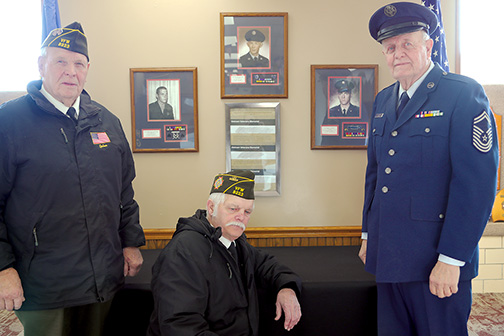
 Galen Johnson, Ken Kelberlau and Ze Heller all served in Vietnam in the 1960s. They stand in front of the portraits at the VFW Hall of Darrell Hovenden, Edward Scott and Henry Limbach who died in Vietnam. March 29 Vietnam War Recognition Dayby Mary Le Arneal Wednesday, March 29, is National Vietnam War Veteran’s Recognition Day. It was 50 years ago, on March 19, 1973, that the last of 2,709,918 GIs to serve in Vietnam were on active duty, leaving the protection of the country to the South Vietnamese. This was after the signing of the Paris Peace Accords in 1973. The war actually ended with the fall of Saigon in April 1975. The number of servicemen who served in Vietnam accounted for 9.7% of the youthful generation at that time. Of that number, 58,202 were killed, most in combat, others in non-combat situations. Sixty-one percent of those deaths were 21-years-old or younger. Though the first soldier to die in Vietnam was in 1958, the official start of the non-official war, called a conflict for many years, was Aug. 5, 1964. There were demonstrations against the war. If you saw “Forest Gump” you will have seen what some of the bigger cities had in protests against the war. It wasn’t the same in small towns like North Bend. Doug Wamberg served on a Navy Landing Ship Dock, the USS Catamout, and on a Landing Craft Utility as an electrician from 1963 to 1964. He was in and out of Saigon working on smaller landing crafts. He returned home without fanfare, saying no one paid attention to him. “I’m thankful I made it back. Others didn’t,” Wamberg said. “That’s why I do this – at the park, in veteran’s groups.” Ken Kelberlau served in the Army, 4th Infantry, 4th Engineer Battalion D corps as a combat engineer. His job was to sweep for mines, dispose of captured enemy equipment and repair fencing. He was stationed near Pleiku in the central highlands of Vietnam near Cambodia. He said the government saw they had a farm boy and got Kelberlau to lay barbed wire. “I laid more barbed wire my year there than I did my whole life on the farm,” he said. After a year in Vietnam, Kelberlau served the 1st Engineer Battalion in Germany before returning home. He said his reception was all right. Read the full story in the print or e-edition. <<Back to the front page |